
Yesterday, July 27, 2023, I attended the webinar hosted by the UC FGR team on Federal Student Loan Repayments. The meeting provided critical information for federal student loan borrowers as the payment pause ends and repayment resumes in October 2023. Key programs were discussed that can help lower monthly payments and provide loan forgiveness, including the new SAVE repayment plan, the one-time IDR account adjustment, and Public Service Loan Forgiveness. Borrowers were advised to update their contact information, enroll in an income-driven repayment plan, and consolidate FFEL loans by the end of 2023 to take advantage of the new programs and waivers. The options discussed can benefit a wide range of borrowers across income levels, loan types, and professions. Read the FAQs below for information I thought pertinent to graduate and professional students and alumni.
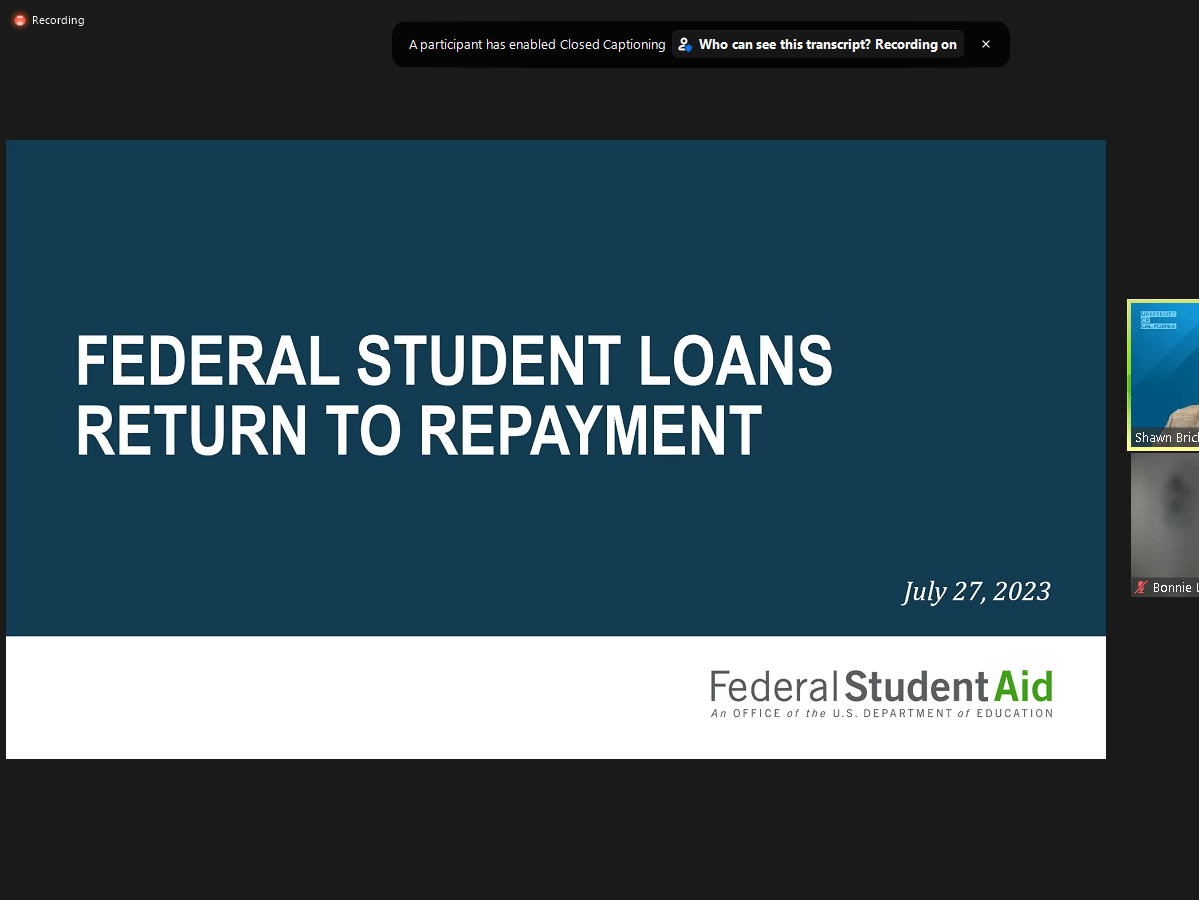
Here is an overview of the key points from the meeting:
• The payment pause on federal student loans is ending in October 2023. Borrowers should prepare by updating their contact information, enrolling in an income-driven repayment plan like SAVE, and signing up for auto-pay if possible.
• The new SAVE repayment plan offers lower monthly payments due to increased income protection and lower payment percentages. However, it will not be available until next year. Borrowers should enroll in REPAYE now to get a lower payment and then transition to SAVE when available.
• The one-time IDR account adjustment will give borrowers credit for past periods that may have knocked them off track, potentially qualifying them for forgiveness sooner. Borrowers with FFEL loans should consolidate by the end of 2023 to take advantage of this.
• Public Service Loan Forgiveness requires 120 qualifying payments while working for an eligible employer. The payment pause periods count toward PSLF as long as the borrower would have been in repayment.
• The PSLF waiver gives borrowers credit for past periods that may have disqualified them, but borrowers must consolidate by the end of 2023 to take full advantage of the waiver.
• Income-driven repayment plans, PSLF, and the new programs and waivers can benefit borrowers across income levels, loan types, and professions, including graduate students, adjunct professors, and high-income borrowers.
FAQs
What significant points might be relevant to graduate and professional students?
- Graduate loans are eligible for income-driven repayment plans like PAYE, REPAYE, and the new SAVE plan. This can help lower your monthly payments.
- Graduate loans are eligible for Public Service Loan Forgiveness if you work for a qualifying employer.
- The one-time IDR account adjustment and PSLF waiver can help give you credit for past periods that may have knocked you off track, benefiting graduate loan borrowers as well.
- The new SAVE plan will offer lower monthly payments for graduate loan borrowers, though they will not qualify for the 5% payment amount available to undergraduates. They will still see a benefit from the increased income protection amount.
- Consolidating graduate loans into direct consolidation loans can help you enroll in an income-driven repayment plan and qualify for programs like PSLF.
- If you have graduate and undergraduate loans, you will get a weighted average payment amount that can lower your monthly payment.
What information is pertinent to borrowers with jobs such as professors, medical staff, and other high-paying jobs?
- Income-driven repayment plans: Income-driven repayment plans like PAYE, REPAYE, and the new SAVE plan can help lower your monthly payments, even if you have a high income. These plans base your payment on a percentage of your discretionary income, not your total income.
- Public Service Loan Forgiveness: If you work for a qualifying employer like a government agency or nonprofit, you may be eligible for Public Service Loan Forgiveness after 120 qualifying payments, even with a high income.
- IDR account adjustment and PSLF waiver: The one-time IDR account adjustment and PSLF waiver can help give you credit for past periods that may have knocked you off track, potentially helping you qualify for forgiveness sooner.
- The new SAVE plan: The new SAVE plan will offer lower monthly payments for all borrowers, including those with high incomes, due to the increased income protection amount and lower payment percentages.
- Consolidation and income-driven repayment: If you consolidate your loans into a direct consolidation loan, you can enroll in an income-driven repayment plan and qualify for programs like Public Service Loan Forgiveness.
- Partial financial hardship: Even with a high income, you may have a “partial financial hardship” that qualifies you for an income-driven repayment plan with a lower monthly payment.
Here are some critical highlights for adjunct professors:
- Adjunct professors can qualify for Public Service Loan Forgiveness as long as they work the required minimum hours, which are now calculated more fairly based on credit hours taught. The Department of Education now uses a 3.35 multiplier to determine how many work hours your credit hours taught equate to.
- Income-driven repayment plans like PAYE, REPAYE, and the new SAVE plan can help lower monthly payments based on adjunct income, which is often lower than that of a full-time professor.
- The one-time IDR account adjustment and PSLF waiver can give you credit for past periods that may have disrupted your progress, potentially helping you qualify for forgiveness sooner.
- By consolidating your loans into a direct consolidation loan, you can enroll in an income-driven repayment plan and qualify for programs like PSLF.
- Even with part-time work, as long as you meet the minimum requirement of 30 hours per week across multiple jobs, you can qualify for PSLF. Volunteer work does not count toward the hours requirement.
- The new SAVE plan will offer lower monthly payments for all borrowers, including adjunct professors, due to the increased income protection amount and lower payment percentages.
What jobs qualify for PSLF?
The following types of jobs qualify for Public Service Loan Forgiveness:
- Jobs with government agencies at the federal, state, local, or tribal level. This includes the military, public schools, public colleges, and universities.
- Jobs with not-for-profit organizations that are tax-exempt under Section 501(c)(3) of the Internal Revenue Code and provide qualifying public services. This includes many social services, public health, emergency management, public safety, public interest law, early childhood education, and service for the elderly and persons with disabilities.
- Jobs with not-for-profit organizations that are not 501(c)(3)s but provide other eligible public services, including public service for the elderly and persons with disabilities, public health, public education, public interest law services, public safety, and early childhood education.
- Religious activities and related roles, including work for religious organizations, are now considered qualifying employment.
To qualify, the job must be full-time, requiring at least 30 hours of work per week. Part-time jobs can count if they add up to 30 hours across multiple employers. Volunteer work does not qualify.
By when should a borrower consolidate their loans?
Borrowers should consolidate their loans by the end of this year (December 31, 2023) if they want to take advantage of the one-time IDR account adjustment and PSLF waiver. Consolidating by the end of the year will:
- Give you credit for past periods that may have knocked you off track, potentially qualifying you for forgiveness sooner.
- Count all of your pre-consolidation payments toward PSLF and IDR forgiveness, rather than using a weighted average.
- Allow you to enroll in an income-driven repayment plan to lower your monthly payment amount.
Consolidating after the end of the year will still provide some benefits, but you will not get credit for as many past payments and periods.
However, borrowers who may qualify for the “hold harmless” period for PSLF should wait to consolidate until more guidance is released to avoid inadvertently being locked out of that benefit.
Why do we need to consolidate loans for PSLF?
We need to consolidate loans to qualify for PSLF for a few key reasons:
- Only direct loans qualify for PSLF. Consolidating federal loans into a Direct Consolidation Loan makes them eligible. This includes loans like FFEL, Perkins, and some Federal Family Education Loans.
- Consolidating allows you to enroll in an income-driven repayment plan, which is one of the requirements for PSLF. Not all loan types are eligible for IDR plans.
- By consolidating before the end of 2023, you can take advantage of the one-time IDR account adjustment and PSLF waiver. These will give you credit for past periods that may have knocked you off track, potentially qualifying you for forgiveness sooner.
- Consolidating combines your multiple loans into one loan with one servicer, making it easier to track your progress and qualify for PSLF.
In summary, consolidating your federal loans into a Direct Consolidation Loan makes them eligible for the programs and repayment plans required to qualify for PSLF.
Do loans on deferment while in school count?
Loans in deferment while you are in school generally do not count toward PSLF or IDR forgiveness. Here are the details:
For PSLF:
- Only months spent in repayment on a qualifying repayment plan count toward the required 120 payments.
- Months in deferment, including in-school deferment, do not count as qualifying payments.
For IDR forgiveness:
- Only months spent making qualifying payments count toward the required number of payments for IDR forgiveness (typically 20-25 years worth).
- Months in deferment, including in-school deferment, do not count as qualifying payments.
However, there are some exceptions:
- Under the one-time IDR account adjustment, certain periods of deferment before 2013, excluding in-school deferment, will count toward IDR forgiveness.
- Under the PSLF waiver, some periods of deferment during the payment pause will count toward PSLF, but in-school deferment will not.
Student loans in deferment generally do not count towards loan forgiveness programs like PSLF or IDR, with few exceptions.
📢 Calling all graduate and professional students! Join the movement for transformative change in education. Opt into the UCGPC fee with just $7 and be part of a powerful collective advocating for equity and accessibility. Let’s show the world the strength of grassroots organizing. Together, we can shape policies in Congress that redefine education, healthcare, and communities. Support a people-centered system that recognizes education as a fundamental right. Stand up, take action, and be the change we need. #UCGPCFee #TransformEducation #StudentsUnite

 Official Blog | UCGPC
Leave a comment