

The University of California (UC) system is committed to providing high-quality graduate and professional education to students from all backgrounds. Mentorship plays a critical role in the success of graduate and professional students, yet there is currently no system-wide set of mentorship standards at UC. This lack of standards has led to inconsistencies in mentorship practices and accountability for faculty mentors. As a result, many graduate and professional students are not receiving the support and guidance they need to succeed.
In a 2023 UCGPC systemwide poll, some student testimonials answered the question: “Provide an example of good mentorship you have received.”
- “None on campus. I’m on my third advisor. When we met, he immediately stated, “We need to get you prepared for your career.”
- “I asked my academic advisor to meet and check I’ve taken all the courses I need and they replied within 24 hours. We met the next week and I received very effective and efficient help on what documents I was missing and how to remedy the situation so I could graduate come spring.”
- “She is generous with authorship and pushes you to write a lot so you have a decent number of publications on your CV by the time you are ready to graduate.”
- “my advisor is always helpful whenever I have questions or struggles relating to my research and is quite understanding when I have had difficult times and has been accommodating during times of difficulty “
For the question: “What are areas for improvement in your current mentorship?”
- “Discussing my long-term goals and how I can build skills to become an independent researcher “
- “More organization in funding resources. For example, TAships are not automatically given and typically can be difficult to secure. Other departments do not operate this way, but for the graduate group system they do. Filing fee process is abysmal. It is impossible to plan for filing fee, whether it will be accepted, and if not, the requirement to pay for a quarter, possibly out of pocket due to lack of TA opportunities and last-minute decision of this status
- “Showing up”
- “This one is too new. In my two previous ones, being deceptive, intentionally holding me back, not reading my papers or providing proper feedback, holding grudges due to miscommunication, gossiping, telling me that I should not be in graduate school—in sum, they can be more supportive, not have temper tantrums, not demand how I should write my research, provide useful feedback, provide experience writing articles, help guide me into my career goals, groom me for conferences.”
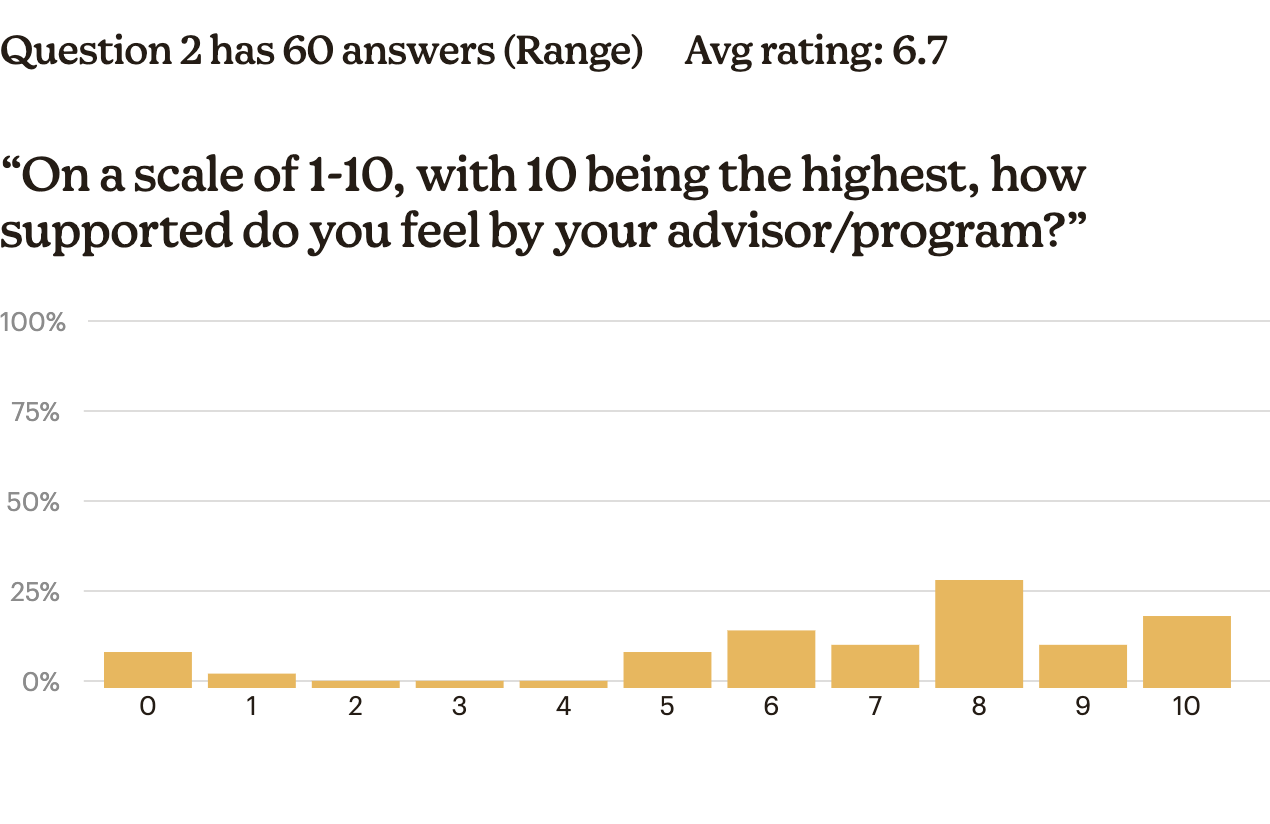
Out of 60 respondents, a small sample largely representing STEM graduate students in Davis, they rated their current advisor mentorship at 6.7 out of 10. Thirty-nine of the respondents were in doctoral programs in STEM fields.
On a more dire note, the current lack of mentorship standards for faculty has resulted in a culture of neglect and abuse, disproportionately affecting marginalized students.
We have received numerous testimonies from graduate students who have been pushed out of their programs instead of nurtured and developed into future academics. These stories are not isolated incidents; they paint a disturbing picture of a system that is failing its students.
In one tragic example, a colleague committed suicide while being pressured to leave the program. In another instance, an undocumented colleague was deemed unprepared for scholarship despite seeking resources and help. A first-generation Latina colleague was forced to get a master’s degree due to a mismatch in research interests with her faculty advisor.
Faculty mentors’ lack of support and guidance has had devastating consequences for many graduate students. One colleague could not finish their program due to giving birth and not receiving adequate mentorship. Two others were forced to get master’s degrees because their advisors were retiring, leaving them without the support they needed to complete their doctoral studies.
STEM graduate students are routinely subjected to excessive workloads, often forced to work overnight in labs for their principal investigators (PIs). This pressure-cooker environment has taken a toll on the mental and physical health of many students.
The lack of accountability for faculty mentors has allowed this culture of neglect to persist. Graduate students are not considered apprentices or future colleagues by many academic faculty; instead, they are treated as disposable labor.
The consequences of this neglect are particularly acute for marginalized students, including women of color, international students, undocumented students, nontraditional graduate students, students who are primary caregivers, chronically ill students, disabled students, and first-generation students. These students face additional challenges, such as language barriers, cultural differences, and a lack of resource access.
The University of California must act now to address this crisis. We must establish clear mentorship standards for faculty and hold them accountable for their actions. We must provide resources and support for marginalized students. And we must create a culture of respect and inclusion for all graduate and professional students.
Past Efforts to Institutionalize Faculty Accountability to Graduate and Professional Students
Despite the importance of mentorship in the success of graduate and professional students, there has been a lack of systematic efforts to hold faculty mentors accountable for their actions. This has led to inconsistencies in mentorship practices and a lack of support for many students.
In recent years, several initiatives have been aimed at institutionalizing faculty accountability to graduate and professional students. These efforts have focused on developing mentorship standards, promoting equity, and creating accountability mechanisms.
In 2018, the UCOP Coordinating Committee on Graduate Affairs created a draft on mentorship standards. This draft outlined expectations for faculty mentors, including providing guidance and support to students, respecting their autonomy, and upholding ethical standards.
In 2017, UCSA also created a draft for mentorship standards. This draft focused on the importance of communication, collaboration, and mutual respect in the mentorship relationship.
In 2020, the UCR GSA also created a bill of rights and responsibilities of and for graduate students that included mentorship standards. This bill of rights outlined the rights of graduate students to receive quality mentorship, including the right to respectful treatment, constructive feedback, and timely responses to inquiries.
These are just a few examples of efforts to improve faculty accountability to graduate and professional students. While much work still needs to be done, these initiatives provide a foundation for further progress.
The Need for Continued Efforts
Despite these efforts, there is still a need for continued efforts to institutionalize faculty accountability to graduate and professional students. This is because the lack of accountability has significantly impacted the success of many students.
Developing clear and enforceable policies is one of the most important ways to improve faculty accountability. These policies should outline expectations for faculty mentors and provide mechanisms for reporting concerns about mentorship. In addition to developing policies, institutions should also provide training for faculty members on effective mentorship practices. This training should cover communication, cultural sensitivity, and conflict resolution.
Finally, institutions should create a culture of support for graduate and professional students. This includes providing resources for students who are experiencing problems with their mentors, as well as mechanisms for reporting concerns.
A Way Toward Faculty Accountability
Mentorship plays a critical role in the success of graduate and professional students, yet it is often not explicitly considered in faculty tenure and promotion decisions. This lack of consideration can lead to faculty members who are not influential mentors being promoted, which can hurt the success of graduate and professional students.
To ensure that mentorship is adequately considered in faculty tenure and promotion decisions, the University of California (UC) should adopt the following recommendations:
- Require faculty members to submit a mentorship statement for their tenure and promotion reviews. This statement should describe the faculty member’s approach to mentorship, including their expectations for mentees, the resources they provide to mentees, and their track record of success in mentoring students.
- Develop a set of metrics for evaluating faculty mentorship. These metrics could include the number of students the faculty member has mentored to graduation, the number of publications or conference presentations that the faculty member has co-authored with mentees, and the satisfaction levels of mentees with the faculty member’s mentorship.
- Provide training for faculty members on effective mentorship practices. This training could cover setting clear expectations, providing constructive feedback, and building relationships with mentees.
By adopting these recommendations, UC can ensure that mentorship is equally important as research and teaching in faculty tenure and promotion decisions. This will help to create a more supportive and equitable learning environment for all graduate and professional students.
Metrics for Grad Student Attrition and Success
In addition to the recommendations above, UC should also develop a set of metrics for tracking graduate student attrition and success. These metrics could include the following:
- Time to degree: The average time it takes for students to complete their degrees.
- Graduation rate: The percentage of students who graduate from their programs.
- Publication rate: The number of publications students co-authored with their faculty mentors.
- Employment rate: The percentage of students employed within six months of graduation.
These metrics can be used to hold faculty members accountable for the success of their mentees. Faculty members with high student attrition or low student success rates should be subject to additional scrutiny during their tenure and promotion reviews.
Conclusion
By including mentorship standards in faculty tenure and promotion decisions and by developing metrics for tracking graduate student attrition and success, UC can create a more supportive and equitable learning environment for all graduate and professional students. This will help to ensure that UC continues to be a leading institution for graduate and professional education.

 Official Blog | UCGPC
Leave a comment