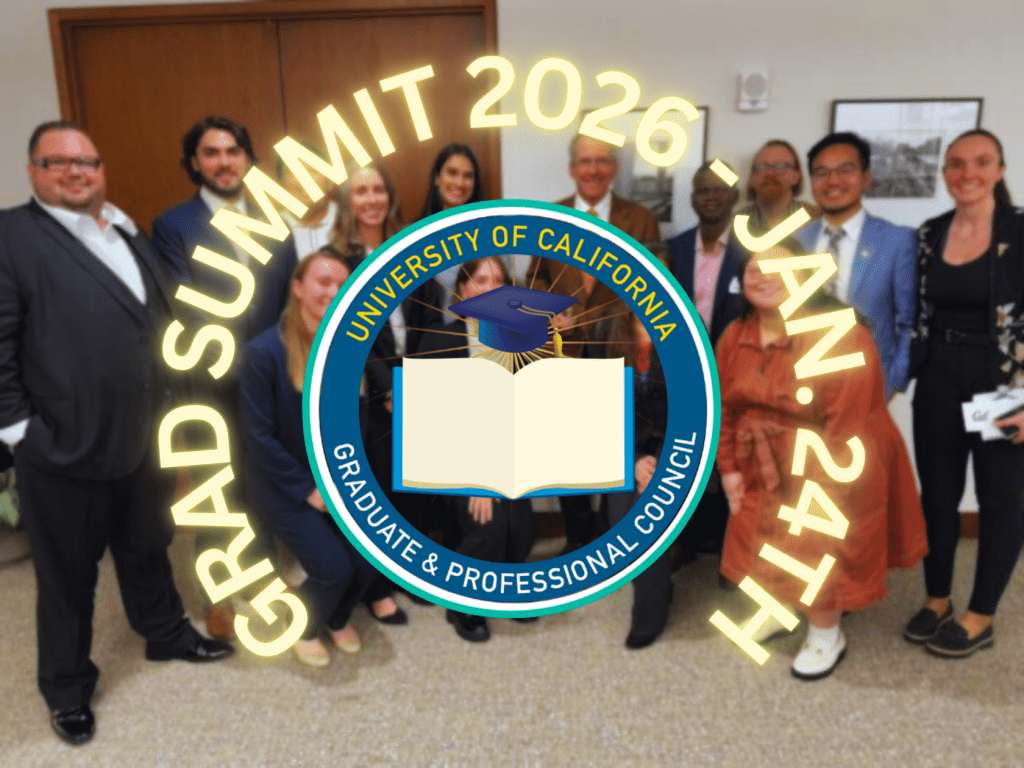
At our successful Grad Summit 2025-26, UCGPC President, Stephanie Valadez, delivered an important State of the Council Address. Check it out in full below:
“I would like to start by taking the time to acknowledge the access, privilege, and opportunity that we all have as a direct result of the dispossession of the communities that lived in concert with, and as stewards of the land long before the University of California occupied this space. As direct beneficiaries of the heinous acts leading up to and through the formation of land grant universities, I acknowledge that I am, and everyone else on the UCLA campus are now occupying the ancestral lands of the Gabrielino Tongva people, who lived on and cultivated the land for thousands of years before settlers arrived, subsequently stealing their land, enslaving their people and forcing them into labor. Every campus has a similar dark history, and I invite you all to take the time to investigate your campus.
Let us remember that this land doesn’t belong to us. We can claim it as ours, say it is so, but the land doesn’t belong to us, we belong to the land. I want to recognize the Gabrielino Toongva people as the current stewards of the land and as those from whom we should always take lead from in matters of its care.
WHO AM I?
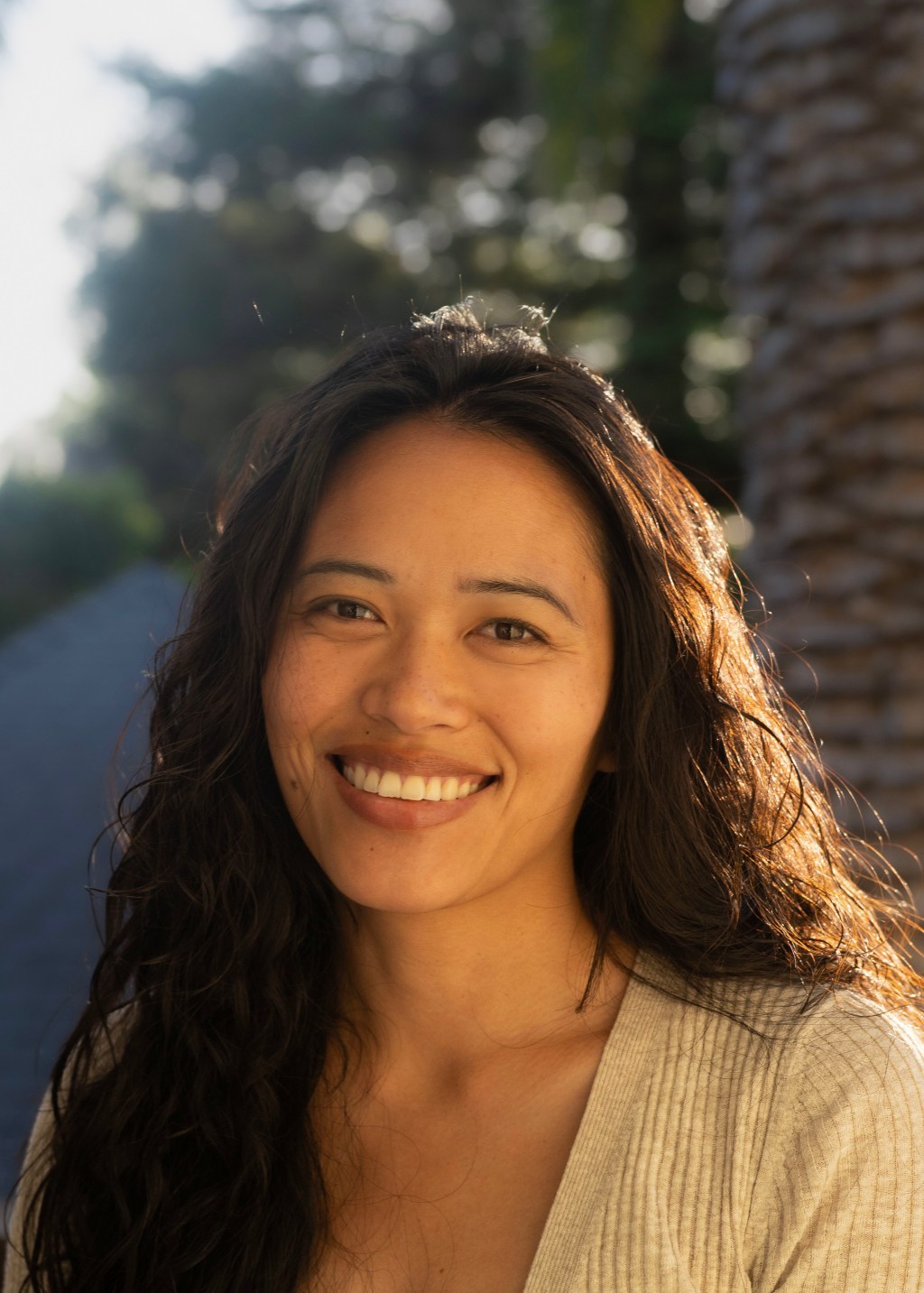
My name is Stephanie Valadez and I am the President of the University of California Graduate and Professional Council. For most of you, I am probably an unknown face. I am a PhD student in Ethnomusicology and Cota-Robles Fellow in the Herb Alpert School of Music at UCLA. I have spent the last three years at UC Santa Cruz studying Cross-Cultural Musicology with a Designated Emphasis in Critical Race and Ethnic Studies.
We don’t typically see artists, musicians or performers in my role, so I would like to explain a bit about what brought me here. If you follow my addresses to the Regents, you will have heard this story before, so please bear with me, while I explain the moment I was moved to advocate at the systemwide, state, and federal levels.
The night of May 30th, 2024, I was off-campus for a meeting while my two children were in the care of a babysitter through the Bright Horizons Childcare Program. Shortly before midnight a force of hundreds of police in riot gear descended on the Santa Cruz campus pulling from police departments from across the state to conduct the Police Raid on the Gaza Solidarity Encampment. When returning to campus, police officers stopped me and threatened me with arrest despite explaining that I was the only parent here for my young children. I needed to get home and relieve the babysitter. I pleaded to the officer’s humanity and in one final forceful demand he made it clear that no matter what path I tried to take or mode of entering the campus, I would be arrested. I cried on the phone to my babysitter, and she promised to stay. While waiting in a nearby parking lot, I watched police with their names and badge-numbers covered with tape and bodycams removed, as they brutalized my unarmed classmates. I alternated between driving back and forth to campus in unsuccessful attempts to go home and watching from afar through my peers’ livestreams and clandestine posts. Feeling entirely hopeless, I knew I failed my duties as a mother for having brought my babies into this country, to this University.
Finally, at 6:30 in the morning I arrived on campus to my home, where my babysitter had been signed out since 11:30 the night before by her employer, and by extension, the University. It was only out of the goodness of her heart that my two children were not left unattended for 7-hours because of the school’s negligence and gross mishandling of the situation. My children already struggle with separation anxiety from immigration trauma, and that night, my toddler woke to find his worst nightmare actualized at the hands of the University. He woke to find his only remaining parent in the household was now also gone.
The University acted impulsively, endangered my children, and caused our family significant harm. This was not the first time my expectations of the University were left unmet. After five quarters of excusing the University taking advantage of my family’s vulnerabilities, I could no longer rationalize and excuse the University’s actions and culpability for the impossible rent burden, the health concerns from moldy carpets, the asbestos in our floors, the peeling lead paint on our walls, the termites swarming out of our windowsills, the rusty nails where our children play, the falling retaining walls, and so much more. Despite my overburdened work and study schedule, this was the motivator for me to find my way here, in this position, to represent students with similar stories.
WHO IS UCGPC?
I became heavily involved with UCGPC, a 501c3 non-profit organization that represents over 63 thousand graduate and professional students across the ten campuses of the University of California. UCGPC uplifts student voices through education, advocacy, and community-building so that every UC graduate and professional student can thrive academically and personally. Here at UCGPC, we strive for an equitable UC system where basic needs are met, mental health is prioritized, and research, teaching, and public service flourish. In our work, we aim to be equitable, transparent, collaborative, sustainable, and inclusive. It is of the utmost importance that all of our advocacy is evidence-based and that we take every step with integrity and respect.
Now you must be asking, “How am I represented?” The voting members of the UCGPC board is made up of the External Vice Presidents from every campus. Each EVP goes through the nomination and voting process on their home campus, then joins our board as ex officio board members to represent all of you. Subsequently, the EVP’s process the applications, interviews, and voting for the officers of UCGPC.
Besides myself, our other officers are
- Vice President, Harvir Kaur at UC Berkeley,
- Secretary, Ramiro Cabanillas-Ledesma at UC Davis,
- and Treasurer, Melanie Girod at UC Berkeley.
Our EVPs are:
- José Aguilar at UC Berkeley,
- Jalen Ward at UC Davis,
- Jake Melton at UC Irvine,
- Jack Feng at UCLA,
- Andrew Martin at UC Merced,
- Gregory Hutchins at UC Riverside,
- Oluwatosin Jegede at UC San Diego,
- Gabe Avillion at the Academic School at UC San Francisco,
- Margaret Akey at the Professional School at UC San Francisco,
- Sarah Bacon at UC Santa Barbara, and
- Gabrielle Peñaranda at UC Santa Cruz.
If you haven’t met the EVP at your home campus, I invite you to reach out and say, “Hello.”
UCGPC PRIORITIES
Before the start of the academic year, UCGPC conducted a systemwide survey on what matters most to graduate and professional students. You all came back to us with clear priorities:
- 1. Basic Needs, including healthy food, affordable housing, and childcare;
- 2. Immigrant, Undocumented and International Protections; and
- 3. Accessible healthcare and mental wellness services.
Additionally over the summer, UCLA faced the indiscriminate and unlawful suspension of approximately 584 million dollars in federal research funding, which jeopardized approximately 800 critical research projects. Negotiations with the federal government have been looming with the proposed fine of 1 billion dollars and proposed changes across the UC system that include “[R]estrictions on peaceful protests, changes to admissions fair practices, limitations on gender identity accommodations in housing and athletics, elimination of scholarships based on race or ethnicity, and the appointment of an external monitor to enforce compliance.” Negotiating the federal landscape has been a top priority as it affects each and every one of us related to the other initiatives and basic student life. While the fight for funding is on-going, UCGPC has been working across the board to support students holistically through advocacy at the systemwide, state, and federal levels. This also entails addressing the complicated changes the University of California has experienced over the last 5 years. In recent years, there has been growing concern about free speech, the University’s investment practices, and our complicity in war, human rights violations, and the down-turn of liberties across the globe.
HIGHLIGHTS OF THIS YEARS ACCOMPLISHMENTS
In the last 6 months, UCGPC has sponsored 8 students to attend the UC Board of Regents Meetings as Student Advocates to the Regents through our “StARs Program”. These students have raised a range of issues including:
- divestment,
- protections for undocumented students,
- funding for international students in the research space,
- and the importance of policies against sexual harassment and abuses through the use of AI.
UCGPC has also worked together with the Office of the President to put student representatives on systemwide committees including
- the Academic Planning Council;
- the Board of Admissions & Relations with Schools;
- the Coordinating Committee on Graduate Affairs;
- the Global Climate Leadership Council;
- the University Committee on Affirmative Action, Diversity, and Equity;
- the University Committee on Academic Freedom;
- the University Committee on Internal Education;
- and many others.
UCGPC is also in close contact with the Office of the President and the UC Regents through
- monthly meetings with President Milliken,
- bi-monthly meetings with Chair Riley and Vice Chair Anguiano,
- monthly meetings with the State Government Relations team,
- biweekly meetings with the Federal Government Relations team,
- Biweekly meetings with the Basic Needs team
- monthly budget consultation calls, and
- We are in constant contact with the Office of Student Equity and Affairs.
Additionally, this year, we are excited to announce the start of a new program, Student Advocates, in partnership with the Federal Government Relations team at UCDC and UCAN. This program features a graduate or professional student from every campus that is engaging directly with the issue of federal funding. They will be collecting testimonials and working with the various teams to support efforts to regain lost funding and protect our other sources of government funding. Lastly, UCGPC has also supported student voices at the State government level through Assembly Committees, including at the California Assembly Committee on Natural Resources and the Assembly Committee on Higher Education.
LOOKING AHEAD
On March 3rd and 4th, UCGPC will be in Sacramento meeting with our elected officials advocating on behalf of students’ needs and the betterment of the University of California. This is an opportunity to engage at the state level and propose alternatives to offset complications with the federal government. We are looking to strengthen the support for immigrant and international student protections, find alternative funding sources for research, and strategize stronger programs for affordable housing and accessible healthy food.
April 20-22, UCGPC will be in Washington D.C. Our main priorities in D.C. will be protecting funding for higher education, advocating against rule changes that drastically affect visa holders, and asking for the reinstatement of crucial funding for diversity programs for Minority Serving Institutions.
This is a time for the UC community to come together and stand strong with our shared goals, shared values, and shared experiences. The UC community of staff, faculty, and students is over 500 thousand. With alumni, our community is over 3 million people. We have the power to set precedent and enact real change.
If you would like to engage in our initiatives or have an idea you want us to support, please reach out to your campus EVP, join our monthly board meeting, or send me an email. We also invite all student leaders and interested advocates to join us on either or both of our advocacy trips to Sacramento and Washington D.C. Additionally, if you want to speak directly to the UC Regents, we currently have an open StARs application on our website.
CLOSING
This is a crucial time in the history of higher education in the United States, and we need to advocate not only for our own education, but for the future of higher education as a whole. By extension it is an attack on our society as a whole. Today, we see so much violence. Our communities, families, and neighbors are under attack. Before I close today, I want to take a moment to acknowledge the attack on Minneapolis. The murders of people standing up for what is right, and the devastating disappearing, torturing, and profiting of people across the country by our government. These are not normal times, and it is not the time to look away. Please take a moment to uplift stories of those that are on the ground in Minneapolis or directly affected by the ICE raids; please donate if you have it within your means; and please join the efforts to stop the wrongdoing. This is not a partisan issue, it is about human rights. If you don’t know where to start, please reach out and join UCGPC efforts and our focus on the student perspective.”
 Official Blog | UCGPC
Leave a comment